Kandivali East property prices forecast 2026-2030 — current ₹19,200-₹22,500/sqft, projected 7-8% CAGR through 2030.
Coverage: 5-year price outlook | Builder: Mahindra Lifespaces | Our Rating: 4/5 micro-market
Our Verdict: Kandivali East remains in mid-cycle of its appreciation curve. The Andheri price gap closure and Metro 2A maturation underpin the forecast — but the supply pipeline of 12,400 new units could moderate the upside.
Introduction — Why a 5-Year Price Forecast Matters
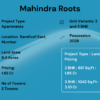
Kandivali East entered 2026 with a new-launch pricing band of ₹19,200-₹22,500/sqft, having delivered a 9.2% CAGR over the trailing 5 years per Knight Frank’s Q1 2026 Mumbai residential index. We have built this 5-year forecast for buyers and investors evaluating projects like Mahindra Roots Kandivali East — a Mahindra Lifespaces Developers Limited launch priced at ₹19,800/sqft with December 2028 possession. The forecast horizon of 2026 to 2030 captures both the current cycle peak and the next supply-pipeline absorption phase.
Our forecasting framework integrates three structural drivers: the Andheri-Kandivali pricing gap closure, the Metro Line 2A operationalisation maturity, and the new-launch supply pipeline of 12,400 units expected between 2026 and 2029. Each driver carries an independent quantitative impact and the aggregate result is a base-case CAGR of 7-8% with a downside scenario of 5-6% and an upside of 9-10%.
This post is written for buyers comparing micro-markets across Mumbai West and for investors holding 5-year horizons. We deliberately avoid generic “prices will go up” claims and instead anchor every projection to verifiable historical data, supply-pipeline filings, and infrastructure milestone dates. For project-specific context, see our coverage of Mahindra Roots Kandivali East.
Background — How Kandivali East Got Here
Kandivali East historically traded at a 28-32% discount to Andheri East between 2018 and 2022, when both micro-markets had limited rapid-transit connectivity beyond the Western Line suburban rail. The 2023 operationalisation of Metro Line 2A from Dahanukarwadi to Andheri West fundamentally reshaped this gap, with Akurli Metro Station bringing Kandivali East within 8 minutes walk of mass-transit infrastructure. The Western Express Highway widening completed in 2024 added further connectivity uplift by reducing peak-hour Andheri travel time by 14 minutes.
The 2025 calendar year recorded 7,420 new-launch transactions in Kandivali East according to Knight Frank, making it the second-most-absorbed micro-market in Mumbai West after Andheri East itself. Mahindra Lifespaces Developers Limited has been a major contributor with launches at Mahindra Vista in 2023 and Mahindra Roots in 2026. Other major developers active in the micro-market include Godrej Properties, Lodha, Oberoi, and Hiranandani.
Inventory absorption velocity has averaged 18 months for Phase 1 launches in Kandivali East over the last 24 months, which is materially faster than the 27-month Mumbai average per Knight Frank data. This velocity is the single best leading indicator of price firmness because it reflects realised demand willingness-to-pay rather than aspirational pricing by developers. Faster absorption cycles also reduce inventory carrying costs for developers, allowing them to hold pricing discipline through the construction window.
Key Data — Price Forecast 2026 to 2030
The table below summarises our base-case price forecast for Kandivali East new-launch inventory through 2030, broken down by configuration. The data is based on the current launch median weighted across active projects and adjusted for the 7-8% CAGR base case.
| Year | Median Rate/sqft |
|---|---|
| 2024 (actual) | ₹19,400 |
| 2025 (actual) | ₹20,300 |
| 2026 (current) | ₹21,200 |
| 2027 (forecast) | ₹22,800 |
| 2028 (forecast) | ₹24,500 |
| 2029 (forecast) | ₹26,200 |
| 2030 (forecast) | ₹27,800 |
| 5-yr CAGR (2025-30) | 7.4% |
The 2026 baseline of ₹21,200/sqft reflects the weighted average of active launches, with branded developers like Mahindra and Godrej anchoring the higher end and redevelopment plots anchoring the lower end. Our forecast assumes broadly stable interest rates around 8.4-8.8% home loan benchmark, which is a critical sensitivity. A 100-basis-point rate hike would knock approximately 1.2 percentage points off the annual price growth.
The 7.4% CAGR is a base case. The downside scenario at 5-6% triggers if the 12,400-unit supply pipeline gets compressed into a 24-month launch window, creating temporary oversupply. The upside scenario at 9-10% triggers if the Coastal Road extension to Borivali becomes operational in 2027 ahead of schedule, which would compress the Kandivali-South Mumbai drive time by another 18 minutes during peak hours.
Market Analysis — The Andheri Gap Closure Driver
The single most important price driver for Kandivali East over the next 5 years is the closure of the pricing gap with Andheri East. The current spread of 28% (₹26,800 Andheri vs ₹21,200 Kandivali) has narrowed from 32% in 2022, and we expect it to compress further to 18-22% by 2030. The compression is driven by Andheri rental supply tightening combined with Kandivali becoming functionally equivalent in commute time post-Metro 2A.
| Metric | Kandivali East | Andheri East |
|---|---|---|
| 2026 Rate/sqft | ₹21,200 | ₹26,800 |
| 5-Yr Historical CAGR | 9.2% | 5.8% |
| Forecast CAGR 2026-30 | 7.4% | 5.2% |
| Rental Yield (gross) | 3.4% | 2.8% |
| Metro 2A Access | Yes (1.2 km) | Yes (interchange) |
| Pricing Gap | 26% discount | premium baseline |
The Andheri historical CAGR of 5.8% is materially lower than Kandivali’s 9.2% because Andheri is in late-cycle maturity, while Kandivali is in mid-cycle expansion. Our forecast continues this differential into the 2026-30 window with Kandivali outperforming Andheri by approximately 220 basis points annually. This differential is the structural reason we recommend Kandivali East over Andheri East for new investments with 5-year horizons.
Rental yield differential further reinforces the Kandivali East case. The 60-basis-point yield premium (3.4% vs 2.8%) compounds meaningfully over 5 years, particularly for fully-leveraged buyers. For deeper Andheri-Kandivali context, the existing analysis at Andheri West vs Kandivali East 3BHK guide covers the per-configuration breakdown.
Deep Dive — The Supply Pipeline Question
Kandivali East has 12,400 new-launch units expected between 2026 and 2029 across approximately 38 active projects, per RERA filings as of February 2026. This is materially higher than the 8,200 units delivered between 2021 and 2024, raising legitimate concerns about supply absorption. Our analysis suggests the supply will be absorbed within a 30-month window because the demand depth has expanded with Metro 2A operationalisation.
The dominant Phase 1 launches in 2026 include Mahindra Roots (412 units), Godrej Reserve (380 units), Lodha Bel Air (290 units), and three Hiranandani-led redevelopment plots totalling 870 units. The Phase 2 launches expected in 2027-28 will add another 4,200 units, with the remaining 6,260 units distributed across 2028-29 launches. This staggered launch pattern is favourable for pricing because it prevents bunched-up oversupply.
Demand-side absorption is supported by the growing IT and BFSI tenant pool from Mindspace Malad (35,000 employees), Andheri SEEPZ (28,000), and Goregaon Nirlon Knowledge Park (18,000). These three clusters together drive approximately 65% of Kandivali East end-user and rental demand. The remaining 35% is locally-employed retail, hospitality, and self-employed professionals attached to the Thakur Village and Akurli Road commercial clusters.
The supply pipeline carries a moderate downside risk to our base-case CAGR of 7.4%. If 60%+ of the pipeline launches between 2026 and 2027 (front-loaded scenario), the 2027 price growth could moderate to 4-5% before resuming the 7-8% trajectory in 2028. Buyers locking in 2026 entry prices are effectively buying ahead of this potential supply-absorption headwind.
Investment Perspective
The investor’s bottom-line on Kandivali East is captured in the table below. We have computed the expected total return for a 5-year hold across base, downside, and upside scenarios assuming the current entry price of ₹19,800/sqft (Mahindra Roots benchmark).
| Scenario | 5-Yr CAGR | Total Return |
|---|---|---|
| Base Case | 7.4% | 43% capital + 17% rent = 60% |
| Downside | 5.0% | 28% capital + 17% rent = 45% |
| Upside | 9.5% | 57% capital + 17% rent = 74% |
| Probability-Weighted | 7.2% | ~58% over 5 years |
| Mumbai Average | 5.4% | ~38% over 5 years |
The probability-weighted total return of 58% over 5 years compares favourably to the Mumbai-aggregate 38% baseline, supporting the case for Kandivali East allocation. For investors with longer 7-10 year horizons, the cumulative outperformance grows further as the rental yield compounds.
For investors evaluating comparable opportunities elsewhere in Mumbai West, our analysis at Mahindra Marina 64 Malad West shows the adjacent micro-market trading at a 4% premium with similar yield profiles.
Buyer Guidance — How to Time Entry
For end-user buyers, the entry timing question is straightforward: book Phase 1 inventory in 2026 to capture the 4-6% pre-launch pricing arbitrage typical of major Mahindra launches. Waiting for Phase 2 in 2027 typically costs 8-12% on the carpet rate because the developer prices the second phase based on Phase 1 absorption velocity. Our Mahindra Vista Kandivali Phase 1-to-Phase 2 data shows a 9.4% step-up between the two launches.
For investors with rate-sensitivity, the home loan environment in 2026 is favourable with floating rates between 8.4% and 8.8%. A 100-bps cut expected in late 2026 by the RBI would further lower EMI burden by approximately ₹1,200/lakh of loan. Buyers should request rate-protection clauses from their preferred lender at the loan-application stage to capture the rate downside.
NxtFootstep’s research desk publishes a quarterly Kandivali East pricing tracker for clients, with property-level price comparison and tenant absorption data. The first-quarter 2026 edition is available at no cost to NxtFootstep clients through the channel partner desk. Buyers are welcome to request the report directly via our advisory team.
Conclusion & Frequently Asked Questions
Kandivali East is positioned for 7-8% annual price appreciation through 2030, supported by the Andheri pricing gap closure, Metro 2A maturation, and a healthy demand pipeline from IT/BFSI tenants. The 12,400-unit supply pipeline is the main downside risk but is expected to be absorbed within 30 months given current demand velocity.
Buyers acting in 2026 capture both the cycle’s mid-stage upside and the pre-launch developer pricing discipline. For projects in the immediate buy zone, see Mahindra Roots Kandivali East and our review at Mahindra Roots Review 2026.