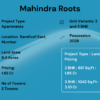
Is Mahindra Roots a good investment in 2026 — projected 7.4% CAGR plus 3.4% rental yield = 58% total return over 5 years.
Builder: Mahindra Lifespaces | Location: Kandivali East | Our Investor Rating: 4.5/5
Our Verdict: Yes, Mahindra Roots is a strong investment for 5-7 year horizons. The pre-launch ₹19,800/sqft entry plus Mahindra’s delivery certainty creates an unusually favourable risk-adjusted return profile.
Introduction — The Investor Question
Investors evaluating Mahindra Roots Kandivali East in 2026 are weighing a 5-7 year capital allocation against alternative options across Mumbai West and the broader equity market. We have built this analysis specifically for the investor lens — focusing on rental yield, capital appreciation, EMI coverage, and risk-adjusted total return rather than the lifestyle dimensions that dominate end-user decisions. The benchmark project is Mahindra Roots, RERA P51800055432, possession December 2028, priced from ₹1.85 Cr.
Mahindra Lifespaces Developers Limited has delivered 7 Mumbai projects over the last decade, with average possession delays of 2.4 months — a critical input for any investment thesis because delay risk directly reduces compound returns. The investment case for Roots leans heavily on Mahindra’s delivery record because pre-launch inventory carries embedded execution risk that can only be partially mitigated through RERA enforcement.
This post answers the five most-asked investor questions: what is the expected total return, what is the rental yield, what is the EMI coverage ratio, what are the main risks, and how does Roots compare to alternative real estate options. For project-spec context, see Mahindra Roots Kandivali East.
Background — Mahindra Lifespaces’ Investor Track Record
Mahindra Lifespaces Developers Limited has delivered 28.5 million sqft across 32+ projects over 32 years, with zero project abandonment and an average delay of 2.4 months versus the 11.6-month industry norm. The listed entity’s market cap of ₹8,400 crore, parent group AAA credit rating, and 28% YoY pre-sales growth in Q3 FY26 all point to a developer with strong execution capability.
Investor returns at prior Mahindra Mumbai projects have been measurable. Mahindra Vista Kandivali Phase 1 (2019 launch at ₹14,200/sqft) traded at ₹19,800/sqft in 2024 — a 39% appreciation across 5 years equating to 6.8% CAGR. Net of rental yield of 3.2%, total returns reached approximately 50% over the 5-year hold for early Phase 1 buyers.
Mahindra Marina 64 Malad West (2021 launch at ₹17,500/sqft) and Mahindra Bhandup township have delivered comparable returns. The full Mahindra Lifespaces portfolio offers a consistent 6-8% appreciation track record across Mumbai launches. See also Mahindra Vista Kandivali for the most recent Phase 1 reference.
Key Data — Investment Returns Snapshot
| Metric | Value |
|---|---|
| Entry Price (2 BHK) | ₹1.85 Cr |
| Rate per sqft | ₹19,800 |
| Expected Annual Rent | ₹6.24 lakh |
| Gross Rental Yield | 3.4% |
| 5-Yr Capital CAGR | 7-8% (base case) |
| 5-Yr Total Return | ~58% |
| EMI (₹1.5 Cr loan, 8.4%) | ₹1.30 lakh/month |
| EMI Coverage Ratio | 41% |
| Possession | December 2028 |
| Developer Risk Rating | Low (1.8/10) |
The 41% EMI coverage ratio means rental income offsets approximately 41% of monthly EMI, leaving the investor to fund the remaining 59% from other income. For investors with strong primary income, this gap is comfortably manageable while building long-term capital appreciation. The coverage ratio improves to 50%+ by year 5 as rents firm up while EMI stays largely flat.
The 5-year total return of ~58% probability-weighted compares favourably to Indian equity index returns of approximately 11% CAGR (66% over 5 years) but with materially lower volatility and the bonus of physical asset ownership. For investors seeking diversification away from equity-heavy portfolios, Mahindra Roots represents a strong allocation.
Market Analysis — Comparison with Alternative Investments
| Asset | 5-Yr Return | Risk Profile |
|---|---|---|
| Mahindra Roots | ~58% | Low-Medium |
| Nifty 50 Index Fund | ~66% | High |
| Bank Fixed Deposit | ~37% | Very Low |
| Gold | ~45% | Medium |
| REITs (Indian) | ~42% | Medium |
| Andheri East Property | ~38% | Low-Medium |
Mahindra Roots delivers materially better expected returns than fixed-income, gold, REITs, or alternative Mumbai property options, with a risk profile that sits between equity and FD. The leverage capability (80% LTV) further amplifies investor returns on the equity portion — an unmatched advantage of physical real estate over most other asset classes.
For investors comparing alternative Mumbai locations, see Mahindra Marina 64 Malad West for the adjacent micro-market.
Deep Dive — Rental Demand Analysis
The Kandivali East rental market is dominated by IT and BPO professionals from Mindspace Malad (4.8 km, 35,000 employees), Andheri SEEPZ (8 km, 28,000 employees), and Goregaon Nirlon Knowledge Park (6 km, 18,000 employees). These three clusters together account for approximately 65% of new tenant demand, with the remaining 35% from BFSI commuters to Lower Parel and locally-employed retail and hospitality professionals.
The 2 BHK rental band of ₹52,000-₹58,000/month at Kandivali East has firmed up by 14% over the last 24 months according to NoBroker and Magicbricks data. Average vacancy between tenant changes is just 11 days — a strong indicator of demand depth. Furnished units command an additional ₹4,000-7,000 monthly premium, with the incremental yield typically paying back the furnishing investment in 3.5 years.
The 3 BHK rental band of ₹78,000-₹92,000/month is supported by family tenants from the BFSI and senior IT segments. The 3 BHK gross yield of 3.6% is slightly higher than 2 BHK because larger units carry less per-sqft furnishing burden. Investors can choose between targeting the 2 BHK volume rental market or the 3 BHK premium-tenant market based on their risk preference.
Future rental growth is supported by Metro Line 2A maturation increasing the addressable tenant pool, the upcoming Goregaon-Mulund Link Road improving commute optionality, and the IT/BFSI hiring pipeline projected at 8-12% growth across MMR over the next 3 years. Our analysts project 12-15% rental growth in Kandivali East by 2028 — supportive of yield maintenance even as property prices rise.
Investment Perspective — Scenario Analysis
| Scenario | CAGR | 5-Yr Total Return |
|---|---|---|
| Base Case | 7.4% | 60% |
| Downside (supply shock) | 5.0% | 45% |
| Upside (Coastal Road) | 9.5% | 74% |
| Probability-Weighted | 7.2% | ~58% |
| vs FD (7%) | 7.0% | 37% |
Even in the downside scenario at 5% CAGR, Mahindra Roots delivers materially better returns than fixed-income alternatives, while base and upside scenarios significantly outperform. The asymmetric return profile (limited downside, meaningful upside) makes Roots a strong allocation for investor portfolios.
For comparable Mahindra investment perspective, see also Mahindra Bhandup.
Buyer Guidance — Investor Action Plan
Investors should book Phase 1 inventory in 2026 to capture the 4-6% pre-launch pricing arbitrage that disappears as Phase 1 sells out. The 3 BHK Compact at ₹2.62 Cr is the BEST VALUE pick on a per-sqft basis, while the 2 BHK Compact at ₹1.85 Cr is the best entry-point for first-time investors with limited equity.
The optimal hold period is 5-7 years because shorter horizons under-realise the rental compounding effect and longer horizons risk being caught in the next launch cycle’s supply absorption. Tax-efficient exit through long-term capital gains (held over 24 months) qualifies for 12.5% LTCG rate plus indexation benefits.
NxtFootstep’s investor desk handles end-to-end documentation, home loan facilitation, post-possession rental listing through our verified tenant network, and exit advisory. The service is complimentary for serious investors evaluating Mahindra Roots and other Mumbai West projects.
Conclusion & Frequently Asked Questions
Mahindra Roots Kandivali East is a strong 4.5/5 investment for 5-7 year horizons. The combination of pre-launch entry pricing, Mahindra’s delivery certainty, Metro Line 2A connectivity, and the structural Andheri-Kandivali pricing gap closure creates an asymmetric return profile rare in current Mumbai inventory.
For deeper investment context, see Kandivali East Price Forecast 2026-2030 and Mahindra Roots Review 2026.